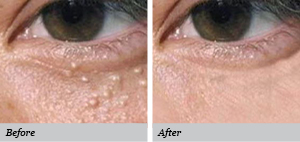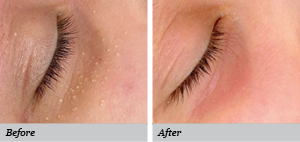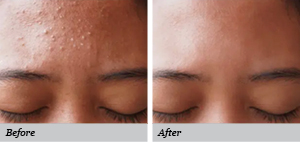
Milia, also known as milk spots, are whitish or flesh-coloured bumps which appear on the surface of the skin, often around the eyes, nose and mouth. They can take months or even years to disappear by themselves, but at sk:n, we are able to safely and effectively remove milia altogether, leaving you with smooth, clear skin. Get your milia assessed by our team in Bristol to find out how we can help you.
Milia are small, raised bumps on the skin usually pearly white or yellowish. They are typically 1-2mm in size and are not painful or itchy. Milium, the plural of milia, tends to gather in groups. They appear most commonly occur around the cheeks, nose, eyes, eyelids, forehead and chest, but can develop anywhere on the body, including on the gums and inside the mouths of infants.Milia can affect anyone at any age, and while they are not harmful, you may dislike their appearance. They often affect babies, and it’s thought that up to 50% of newborns will develop milia.
There are several different types of milia, some more common than others, but the causes of each type are not fully known. Milia can occur when dead skin cells become trapped in the pores under the skin’s surface.
• They can also develop with the skin’s healing response to skin damage. For example, after a burn or rash.
• Sebum production could also contribute to their formation, or obstruction to sweat ducts, like when someone suffers from watery eyes or wears makeup under the eyes.
• Sun damage could also possibly be a cause.
• Milia may also develop after the use of certain creams, such as corticosteroid skin creams.
Q&A
Will Melia go away not its own?
Milia can improve on its own however it can take a long time, sometimes up to a month. Some things you can do to naturally bring the milia to the surface are things like steaming your face to open the pores, and gently exfoliate your skin 2-3 times a week (depending on sensitivity).
Will Melia come back?
Once you develop milia once, it is likely you will develop them again. They are nothing to worry about medically, however, many patients are bothered by them or find their appearance unsightly.
Why is my Melia increasing?
If your milia is increasing it could be a sign you’re overusing heavy creams. It is often thought that milia develops because of under-moisturising, when in fact over-applying the wrong type of skincare product could be the root cause.
Light, non-comedogenic eye creams and face creams are recommended.
What ingredients cause Melia?
Heavy under-eye creams can cause milia, so be sure to avoid petroleum-based ingredients like petrolatum liquid, petroleum oil or paraffins.
Before and After